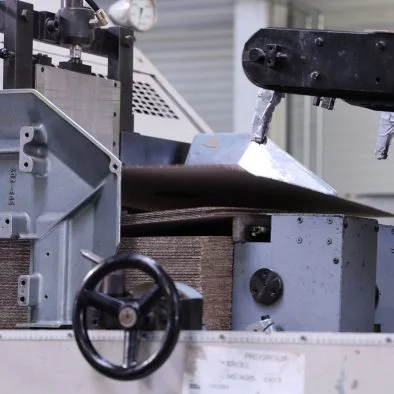
Flatbed die cutting is used when corrugated packaging requires more complex shapes, precise cut-outs or structural details than a conventional slotted box can provide. The process allows corrugated board to be cut and creased accurately using a specially manufactured die, making it possible to produce custom packaging with sophisticated structures and repeatable dimensions.
At Pack & Roll, flatbed die cutting is an important part of our custom packaging production. It is commonly used for die-cut boxes, shelf-ready packaging, protective inserts, display solutions and litho-laminated packaging where precise shaping is essential.
Complex Shapes with High Precision
In corrugated packaging production, die cutting uses a specially designed cutting form to cut and crease the board into the required shape. FEFCO distinguishes die-cut packaging from regular slotted boxes because die-cut designs can require more precise cutting and significantly more complex structures. The two main technologies are rotary and flatbed die cutting; in flatbed systems, the cutting form itself is flat.
Flatbed die cutting makes it possible to create:
- rounded or irregular contours;
- handles and openings;
- windows and tear-out sections;
- locking tabs and self-locking structures;
- internal supports and protective inserts;
- display and shelf-ready features;
- precise crease lines for controlled folding.
This flexibility gives packaging designers far greater freedom than standard rectangular box production and makes the process particularly suitable for customised packaging.
From Approved Design to Cutting Tool
Every die-cut product begins with an approved structural design or prototype. Once the dimensions and form have been finalised, a dedicated die-cutting tool is manufactured for the production run.
This makes the prototype stage especially important. Changes to the structure should ideally be completed before the production die is manufactured, because modifying an existing cutting tool can reduce its service life and create unnecessary additional work. Pack & Roll therefore recommends finalising all shape-related adjustments during the sample development phase.
For new packaging projects, the process can begin with digital structural design and prototype production. The physical sample can then be checked with the actual product before the final die-cutting tool is ordered.
Suitable for Custom and Printed Packaging
Flatbed die cutting is frequently used for packaging where appearance and structural design are equally important.
Custom corrugated boxes often reach the end customer together with the product, so their visual presentation can influence the overall perception of the brand. Depending on the required graphic quality, the board may be flexographically printed or produced using litho-laminated printed sheets before die cutting. Pack & Roll commonly uses flatbed die cutting to convert these more sophisticated printed corrugated sheets into finished packaging structures.
The process is also well suited to shelf-ready and retail packaging, where perforations, removable panels, trays, integrated displays or other functional details must be reproduced accurately across the production run.
Cutting, Creasing and Further Converting
Flatbed die cutting does more than simply cut the outer shape of the packaging. The die can create both cutting and creasing lines in a single production step. The creases define where the board will fold, helping the finished packaging form accurately during assembly. FEFCO describes corrugated converting as the transformation of flat board into finished packaging through processes such as printing, die-cutting, folding and gluing. Depending on the package design, these operations may be carried out separately or in combination.
After flatbed die cutting, some products are already complete as flat blanks ready for assembly. Others require additional finishing operations. At Pack & Roll, certain constructions may continue to folding and gluing, including spine or bottom gluing where required.
Efficient Production of Advanced Packaging
The main advantage of flatbed die cutting is repeatability. Once the cutting die has been manufactured and the process set up, complex packaging designs can be reproduced consistently across the production run. This is particularly valuable when several structural functions must be integrated into one piece of corrugated board. Instead of adding separate components later, features such as tabs, supports, openings or locking mechanisms can often be incorporated directly into the die-cut structure.
Corrugated board itself offers a strong combination of rigidity, low weight and design flexibility. Its layered construction allows it to be converted into a wide variety of shapes while continuing to provide the strength and protection required for packaging applications.
Flatbed Die Cutting from Pack & Roll
Pack & Roll has been manufacturing corrugated packaging since 1996. Our flatbed die-cutting capability supports the production of custom boxes, retail packaging, protective fitments and premium litho-laminated packaging from approved structural design through to finished production.
Whether you already have a production-ready cutting layout or need help developing and prototyping a new packaging structure, our team can support the complete process. Send us your packaging drawing, product dimensions, required quantity and any special structural requirements, and we will help determine the right die-cut solution for your project.